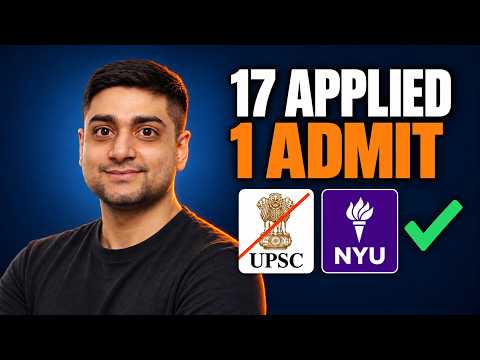
How To Quit UPSC After 2 Failed Attempts & Restart With An MS In The USA - w/ Akash
Akash prepared full time for India's UPSC civil services exam for two years. Eight to nine hours a day, two attempts.
 Life is lived in the arena.
Topic hub
Visas, study abroad, international student life, moving countries, NRI money questions, and the career math that changes when geography enters the room. 18 border-crossing episodes are here.
Akash prepared full time for India's UPSC civil services exam for two years. Eight to nine hours a day, two attempts.
Should an international student still move to the US for a master's right now? That's the question sitting in thousands of inboxes and WhatsApp groups this admissions cycle.

Shreya Shravini graduated from the University of Chicago with a masters in public policy and had every reason to stay in the US. Good job market, OPT STEM extension, a real shot at sponsorship.

Shriya left India for Germany to do a master's in Human-Computer Interaction. Zero — not "discounted," actually free.) If you've been stress-googling "masters abroad" at 2am, stuck in the loop most Indian students hit after a , this is the conversation you needed.

Hari Prasad Renganathan got rejected from the H1B lottery three times. Most people in that situation spiral.

Every year, hundreds of thousands of international students and tech workers face the same terrifying math: there are 85,000 H-1B seats and over 400,000 applications. But what if you didn’t have to play the lottery at all?

Moving abroad for studies often gets reduced to a checklist: applications, visas, internships, and landing that first good job. In this episode of Ready Set Do I sit down with Bhushan Chougule, a graduate student at Purdue University studying Engineering Management, to talk about what most study-abroad advice misses — the small, human things that actually make your time overseas feel like living instead of surviving.

How To Prepare for US Non-Immigrant Visas (ex-US Visa Officer POV). This episode follows the first moves, tradeoffs, and lessons that show up before a story looks clean from the outside.

How does studying in Europe prepare you for launching one of the most innovative companies in a country as complex as India? In this dynamic episode, we sit down with Supra , a global strategy professional who helped expand Tesla into new markets , including India.

People get strange about accents because they confuse sounding local with belonging. Gurasis talks openly about being judged for how he spoke, the pressure to sand down your voice, and the bigger question underneath it: who gets to decide what 'professional' sounds like?

Akshansh joins Naman for a conversation about build A Strong Profile For Masters In USA. In this episode, my nephew, Akshansh who has been a featured not-expert on this show in the past asks me questions about how he can walk a path similar to the one I walked when I started my Masters from the US about 5 years ago from Purdue University before moving to Chicago for work, where I've been living for the past 3 years my links/socials: If cross borders is the mess on your desk right now, this episode is a strong place to begin.

What happens when you move back to India after a master's in the US? Ratik Dutta talks through reverse culture shock, the job market for returning graduates, and the strange work of settling back into a place that is already supposed to feel like home.
Some career stories sound made up until you realize they were built one unglamorous step at a time. This episode follows a mechanical engineer from Indian Railways to SpaceX without pretending the path was neat, linear, or somehow inevitable.

Grad school advice gets weird fast because everyone starts talking like they were born with a polished profile. Unnati breaks down the real work behind an Ivy League MEM admit: the GRE, the SOP, the letters, and the part where you stop trying to sound impressive and start sounding clear.

Money questions get weird fast when you are an NRI on OPT or H-1B and everyone around you has a different opinion. A CFP walks through the stuff people usually learn too late: how to think about investing, what actually deserves attention, and where the common traps are hiding.

A lot of Dubai talk is either glossy or cynical, which usually means it is not very useful. Kaushik cuts through that and talks about moving to the UAE for a PhD, what living there actually felt like, and why the Gulf makes sense for some people and not for others.

Moving to France sounds glamorous until you are the one trying to build a life there in real time. Devendra talks through SPJIMR's global management program, the move to Paris, and the small frictions that shape a new country more than the postcard version ever will.

A master's in the US can be useful, expensive, confusing, and wildly overrated all at once. This episode is about getting more out of the move than a degree and a few blurry orientation photos, especially if you are trying to make the whole thing pay off in the real world.