Episode 107
How to Make $80K on Upwork (From a Top 3% Freelancer) - w/ Anas
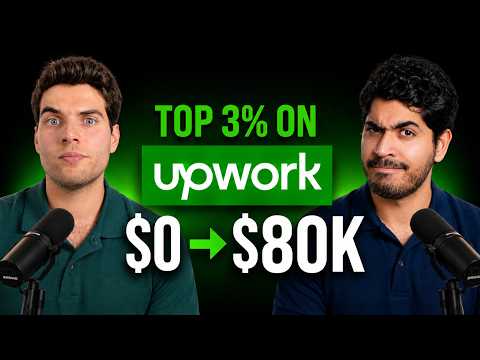
Two years ago, Anas lost his full-time UK job. He went back to Upwork — the platform he'd already used to make over $80K while studying — and within months landed an 18-month Swedish contract that generated over $5M in client revenue.
Who this is for
- You are building something real and need the unpolished version before the launch post.
- You would rather hear Anas's version while the mess is still fresh than get another polished hindsight sermon.
Key takeaways
- Make $80K on Upwork (From a Top 3% Freelancer) - w/ Anas
- Starting on Upwork Before Feeling Fully Ready
- Or, if you've been laid off and no one's calling you back, maybe it's time to look at upwork as a serious alternative....
Need the cleaner version?
I pulled the sharpest parts of this lane into a guide so you do not have to reconstruct the answer from memory later.
Fast scan timestamps
Transcript
The full conversation, right here. Auto-captions, lightly cleaned, still very much a real human conversation.
My wife created a job for me in 2022 as she gave me 5 stars. Anastriyad is in the top 3% of all upwork freelancers. 80,000 US dollars earned till date, completely self-taught. A data scientist originally from Morocco studied in the UK, got fired from his job about two years ago, milked back everything from scratch. It was a shock for me, it was the first time that I lose a job. If you speak like a CEO, like you're there to help the business, improve something, then you're always going to get a project.
If you're trying to make real money in 2026 with freelancing in addition to already having a job, this is the episode for you. Or, if you've been laid off and no one's calling you back, maybe it's time to look at upwork as a serious alternative. I promise by the end of this episode you will know exactly what you need to do to get started and thrive in this world. Please join me in welcoming Anastriyad to the Ready Set Du Parcast. Let's get into it. Anastriyad, welcome.
So, you've had about $80,000 earned just doing freelance work. So, clearly, you know, you're such a flagship at this field. Talk to me about what is the first or biggest thing that most freelancers get wrong when they're trying to first enter the field. Yeah, first of all, thank you for having me here. And, yeah, freelancing is one of those topics a lot of people talk about, because it's interesting, a lot of people want the flexibility of working remotely and choosing your own projects and clients and pricing, and it just sounds very interesting.
And one first misconception that I would say about freelancing is that you need a lot of clients in order to make good money. Unless you are maybe a thumbnail designer or you offer a service that doesn't pay too much, you need volume, but when you're a technical person, such as me, for example, I'm a data scientist, then I can have one or two big clients for long term, and that pays me the same as a normal job if not even more.
So, I would say the first misconception is you need 20 clients in order to make good money. That is a big one to start, I feel like. And I love the contrast you mentioned around the thumbnail designer stuff, because, yeah, the one thumbnail client is not going to put food on your table, right? But with stuff like this, I can see how even one client would go a really long way. So, obviously, we want to jump into kind of how you got here, but I'm curious, can you talk us through your background?
So, was data science something you learned by yourself or did you go to school for it? How did you find yourself having such knowledge in data science? Yeah, so first I had an industrial engineering background. I studied five years of master's degree, I'm from Morocco myself. I studied there, I graduated as an engineer, I worked for a year and a half, and I didn't enjoy it much. So, I was looking for what I could do, something that I enjoy more, and I found that working with data was always something that I was interested in. I wasn't good, but I was interested.
In the department, when I worked as an engineer, there were people specializing in data, and I found sitting with them, working with them, thinking through problems with them, was something that I was interested in. So, I decided to move to the UK. I did a one-year master's degree here in computer science, and that gave me the first step into the world of data. But I didn't wait to graduate before starting to work. While studying, I started doing freelancing, which was an advice from a friend of mine.
He told me, "Just start, slowly get some projects, get some experience, not need to wait until you graduate to start looking what's happening." And I feel like nowadays with, obviously, AI everywhere, this is even more of an important advice people need to hear. Don't wait until you finish in order to start. You can start even at your own level. You'll get smaller projects, definitely. But whatever you get is better than waiting until you finish your studies, and then you start from blank page. You can start by slowly creating.
So, it wasn't as if I was meant to be a data scientist who was far from that. It just happened to be a transition that came naturally to me. So, on that topic of starting out, right, I think, at least on the outside, with the little that I know, what I've found or what my perception is that the freelancing field in general is extremely saturated, right? Because obviously, there's, first of all, no big barriers to start.
Anybody can make an upwork or, you know, whatever, freelancer.com account and just you're a competitor now. So, my question to you is, when you were first doing this, when you were in the UK, getting your degree while starting to dabble with this type of work, like, how does one stand out, right? And first of all, is my perception even right? Is it really that saturated? I mean, if you ask anyone in the job market in general, they will say that it's saturated. Whether it's freelancing or traditional jobs.
It's not real that nowadays the competition is increasing because we have automated tools, like AI, they can do a lot of the work, which means that companies don't need as many people to operate the things that they used to before. Some analysts now in a team can do a lot of the things before you needed maybe five analysts. Maybe today one or two can be enough. So, things are changing. And people are still graduating.
People are still trying to become data professionals or software engineers or tech people. So, obviously, the feeling is that it's saturated. But I can give you an example. When you apply for a job on LinkedIn, for example, you sometimes find that there are more than 500 applicants in one job, sometimes even thousands. When you go on Upwork, and I'm just giving the example of Upwork because it's the one I know better, you go on a job, you don't find more than 50 applicants or 60. So, already you have the 10th 500 compared to 50.
So, yes, there is a lot of freelancers, but it doesn't mean that there is no opportunity at all. So, can you talk us through kind of how you landed your first client? Like, what was that experience like? Did you just apply normally and hope for the best? And it just happened or did you have to jump through a few huge hoops to get there? I had to make a lot of mistakes initially. So, the advantage that I had is I had a friend of mine who was ahead of me and he gave me a few tips. So, he's a senior machine learning engineer. He lives in France and he uses Upwork longer than me. And he's the one that introduced me to the platform. He told me how to look into jobs.
But he didn't show me how to apply, how to stand out, how to do the job. He just gave me a tip for how to start. So, initially, I was just applying. I was going on the platform and I was hoping for the best. I played the volume game. I was applying, applying, applying. And one thing that I will mention here is that I applied even to jobs that I wasn't feeling very qualified to. I felt like I could do 50% of the job I was applying because I'm someone that can figure things out along the way.
If I give me an opportunity and if I know half of it, the second half I will learn how to do it. Just give me time. So, I went from this principle and the initial jobs that I got, sometimes I said, for example, "Do you know how to create dashboards with Power BI?" But I didn't know anything about Power BI. So, the whole weekend and I watched 20 hours of tutorials and I created five dashboards in five hours. And on Monday, I have to sell my skills to that client. So, I did that, you know. And that level of I can figure it out. Instead of I know tools, it's something very valuable.
And the more now I grow in my career and the more I understand that it's all about impact and not all the tools or the skills that I have. If I can deliver quality results, who cares if I did it with Python or SQL or whatever tool that I use? It's more about the impact. So, with this in your first iteration, when you were first trying to break into this space, get your first clients, was it then? Obviously, as you mentioned that a lot of it was just learning that you had to do.
And then once you had done that learning, did it kind of then just fall into your lap a little bit. So, I guess what I'm curious about, Anas, is how does the entire kind of project life cycle work with something like a work, right? So, obviously, somebody posts the requirement, right? Like, this is what we're doing. This is what we need somebody to do. What happens from that point? I guess, can you like talk us through the entire starting there until like the end of the project?
Yeah. So, one thing I wanted to mention before diving into how I work with clients because when someone starts their journey in freelance, it depends how much experience they have. So, for example, Nama, if I speak to you, you have a lot of experience in data analytics. It's not the same as talking to someone that is still studying in university. So, if you have that experience that you can leverage, it makes it easier usually to get your first contracts.
But when you're still studying, you need a lot of convincing and you need to do more effort in order to get those clients. One tip that I also mentioned in my Upwork course is initially, especially if you're something like Upwork, getting your first two projects done is very important because no one wants to hire someone with zero reviews and zero earnings. You know, imagine you want to hire, I don't know, a video editor and you see someone with no reviews, no work. You're very unlikely to hire them, you know?
So, if you want to get those first two projects, something I recommend even to my friends, just ask two members of your family or friends to create some fake projects, hire you and give you fake reviews. I know it sounds a bit like we're playing the game, but you're giving yourself a little head start. And I'm saying this with all honesty, I did it. My wife created a job for me in 2022. She was my girlfriend at the time.
And she hired me and she paid me for a job and she gave me five stars. She said Anna is amazing and all that kind of stuff. Is she even a real one when she's not willing to lie on Upwork for you? It's like the means. I should have known. That's the biggest sign. So, yeah, this is a quick tip. Not many people will say it and I'm not ashamed of saying it. Give yourself a head start. Initially, it might be slow, but over time, things get a little bit easier.
For example, now when I apply and I have over 80,000 in revenue, I'm a top-rate plus freelancer. I have a presence on LinkedIn on YouTube. When I apply, a client sees that I have more chances of getting the jobs. But it took me three years. So, it's not something that you can compare yourself to on the first week or the first month. So, it takes time. I'm coming to, obviously, your question about the project. First, I try to filter so that I can get some projects that make sense. So, something that I am interested in.
The client has a good reputation and the requirements make sense. So, if I read through something and the requirements are unclear, I try to skip it. If the client doesn't know what they want, how can I work with them? It's going to be a lot of problems along the way. So, it's about filtering properly and then it's about scoping the project to the clients. What are they expecting from me? How are they expecting from me to deliver it?
And by when and how many iterations, if there are any changes that need to be made? Because some clients, they might give you a task and then they ask you to change it 25 times along the way. It doesn't work like that. So, setting those clear boundaries from day one is something that you need to get good at as a freelancer. And then once you start there, you're just, you agreed on that set amount, right? Like, this is what you want me to build. And then you continue to build it to rate demo. And at the end, you're like, here's what you wanted. Maybe they'll ask for a revision, maybe not. And then that's pretty much you're done, right?
So, when you think of freelancing, you need to think of a one-off project where a client hires you to do one thing. Or you have a continuous work where you're paid 20, 30, 40 hours per week. And it's like you are an employee, but you're paid as a consultant or as a freelancer. So the first one, yes, you have deliverables. Sometimes you have milestones. Let's say you're going to build a mobile app. Maybe milestone number one is to plan together.
Milestone number two is to do a quick MVP, muscle number three to deploy the app, et cetera. And you get paid, let's say $1,000 here, $1,000 there slowly. By building, you get paid along the way. But if you're paid hourly, then you're treated a little bit like a normal employee. It's just that you have the status of freelancer. I actually had no idea about the ongoing type of freelancer. I always used to think these are very finite projects. And the definition of a project is that it's finite. Like that it will end soonish. So this is really cool. I actually had no idea. And then something else that you said also stuck out to me.
You mentioned that it took you like a three year grind to get to where you are right now, which is, you know, a top rate developer. Pretty much everybody just hires you immediately on a purchase as soon as it's your profile. So I want to talk about the types of things that you were doing in your first year versus your third year because I'm assuming obviously they would not be the same. So can you help contrast that for especially for a listeners that maybe currently are in their first years and they're trying to start to branch out, get bigger, get just, you know, get better at what they do. So what would be that contrast that you have?
You know, if we just take the example of a normal job, when you start out, you don't You try to discover, you try things, people teach you, they show you the environment. And slowly over time, you get used to things. You automate your processes and you optimize the way you work. When I started, my proposals were really bad. I used to write very long proposals. It's like cover letters. And they were all over the place.
I tried to put everything that I knew, even if they weren't relevant to the job. When I was applied for jobs, I was applying to everything that was nearly enough in my niche or my area of expertise. So just these mistakes are quite big. If you go up work, Upwork has roughly 1 million jobs per year that they put on the platform. Insane amount of jobs. If you apply to everything, then you're very unlikely to get those kind of projects that will make you good money and also make you happy to work on something meaningful.
You'll be just working on random projects with random clients. So two things that helped me a lot is to search better, be more diligent when I search. And when I apply, I take my time. I write a proposal that makes sense. I have a framework on how I write my proposals. And I even go the extra mile and send a short video of myself presenting myself to the client and how I can solve the thing for them. We live in a world where everything is automated. We write proposals with AI. We summarize the content with AI. We create designs with AI.
If you just send a 60 second video of yourself, you're going to stand out. And just these small details, I didn't used to do it before. But over time I learned, especially for the jobs that I like, I spend a little bit extra time and therefore I stand out with them. I love that, right? And I love that especially because it just applies to everything in our current world in I agree that, and this is something that's so underrated, I feel people don't talk about this enough, but it has actually never been easier to stand out than it is right now.
Literally all you have to do is do the thing not using AI and that's it, right? Your LinkedIn post will stand out. Your YouTube videos will stand out. It's just so easy now. And I love that you call that out. The other thing that you mentioned around the proposal stuff, right? So I know that you almost have to position yourself a certain way on a work. So how should one be thinking about that? Are you more project heavy or are you more skills heavy in terms of the direction in which you portray yourself on the platform? I think people should see themselves from an outside angle.
If you look at your own profile or you look at your own proposal, would you hire yourself? Literally, if you spend five minutes looking at your own profile, are you selling yourself Sometimes people, they just stuff their profiles with keywords and they think because they put all the possible keywords in the universe that people will start calling them. And the reality is that that's not how you stand out. There are ways of doing it.
So if we think of a few layers that are quite important in here, your profile. is very important. Whether you use Upwork or any other platform, your profile is important because of two things. One, you rank in search engine optimization in SEO. So when recruiters or clients, they search for certain keywords, they should be able to find you in the top, hopefully the top 10. And second, when you apply for jobs and the clients are interested in your profile, they can go and read more about you. That's why you need to sell yourself.
Your profile page is like a sales page, just like you try to sell them something. But that something is your own expertise. So always lead with the most important part of your work. If you've built something for a client and you've made a few million dollars or you've built a project that helped your company optimize 20% of revenue, whatever thing, start with You say, I have a shit learning engineer. I helped my company make over five million dollars and this lead with it.
And then mentioned the tools, then mentioned client testimonials, then mentioned how many stars you got, all these things. Think of yourself as someone who is trying to sell your services. And that's the distinction between having a normal job and being a freelancer or a consultant. You are a solopreneur or you're like a business when you're a freelancer. Because you have to sell your skills. You have to convince clients. You have to deliver. You have to manage your own accounting. You have to negotiate all your projects. So you're not just executing. It's like you're a CEO of your small one person company.
And when you see yourself like this, you start to make the right adjustments for you to stand out, not just as a freelancer, as a business person, basically. And I think on that same topic of being a solopreneur, right? That's when we also have to talk about pricing, right? Because that's again, no one is going to advise you on how to do that. You have to figure out pricing. So I'm assuming that just knowing what I know about human nature. Most people probably start by undercharging, right? I don't know if that's true.
And so what was that like for you and what recommendations do you have around how people should think about pricing their services for technical work on a work? So it's a very interesting topic. And I was lucky that I had a friend of mine that told me to not underprice myself. But the reality is when you're just starting out, you need to get those reviews. And it doesn't matter if you underprice yourself. You just try to get momentum.
And if I told you right now that not money needs to charge $100 an hour minimum, but you have zero reviews on Upwork, you have zero projects, you're very unlikely you got to get any projects The reality is you need to build momentum. And initially, it's fine. It's like you invest in the stock market and you know that the first five years, you're not going to get many returns. It's over time that you get the compounding treated the same way.
Initially, except that you're building momentum and then start pricing properly. A few things that I'd like to mention about pricing is we can sometimes see YouTube videos saying about you should price yourself a certain amount, minimum. But that misses a lot of context. What are the clients that you work with? Are they from the US or are they from India or are they from Morocco? You can't charge the same amount of clients in the US or India. Even if it's for the same job. Are you senior, junior? How many years of experience do you have?
How complex is the work you're trying to do for the clients? All these things come into play before you can price your project. You can't just say, I price minimum $50 an hour. But what if the clients you work with is from a country that doesn't pay that much? Or are you just going to apply for jobs in the UK, in the US and Australia? So these are things that you need to keep in mind. It's not a set amount. It depends with whom you work for how long the complexity of the project and your seniority level.
So one advice that I would say is if you're comfortable charging $20, push it to $30. If you're comfortable charging $50, push it to $70. If the client accepts, you just give yourself a raise. If you don't, you still paid what you wanted to be paid. So always overcharge a little bit. Worst case, you fall back where you wanted it anyway. Yeah, I like that. And also actually on that same note is negotiating a thing that's common on Upwork.
Is that acceptable in the culture of the Upwork world to negotiate with freelancers or not really? Yeah, I mean, of course it is. Initially they set a budget. You agree on it or you can do your own proposal. That's why I say seniority matters. If the client is really interested in you and you're good at that specific thing, then maybe you can convince them to pay you more for it. And then so also continuing down that same road, one of your videos that went really widely even your LinkedIn post around this was helping your, one of your clients get to 5 million in ARR.
Just, you know, with your obviously there was a team, but you were a key part in their data world. I do want to spotlight that because that's just like an insane amount of impact that you were able to create. So can you just kind of talk through that specific project? Like how you landed such a huge big ticket client and how you were able to deliver so much value for that. Yeah, so this client I still work with even these days. So it's a long term client that I got from Upwork.
And that one just came after I lost my job nearly two years ago. I had the full time job here in the UK. And it was a shock for me. It was the first time that I lose a job. The team was downsizing. And I didn't do any freelancing at the time. I did it before that. And then when I got a job I stopped freelancing. So I had a gap one year. And I had to come back to Upwork and start from scratch and everything. And after a month I managed to land this client.
It's a Swedish company and they hired me to do data analytics work basically for them. And it's an 18 month contract. Eighteen, a year and a half that I got from Upwork. And throughout that time I helped them to analyze client data, built a lot of reports for them. And my role was basically to convince the clients that our solution helps them perform better, to sign new contracts for those clients. And all those renewal contract renewals added up to over $5 million for last year in 2014. I mean, and that's such great timing for you, right?
Because after your break I'm sure you were probably pretty nervous about how the world would have changed on Upwork. Is it still the same as it was when you left it? Or has a lot changed? I'm really glad you were able to find such a big ticket client. Was it not an issue for them that they didn't see any recent contributions or projects in the last year? Did that come up at all when you were like interviewing with them?
So when I was interviewed with their CTO, I remember at this time, they asked me a lot about the job. So first of all, I learned how to write good proposals and therefore I was able to get to that conversation. It's important to get to the level where you can speak to someone. That's where the proposal comes into play, the profile optimization come into play. And at the time I started making videos on YouTube as well.
So I could showcase a little bit of how I speak and things like this. So the client gave me a project to work on. They gave me five days and it wasn't just me, it was a few other freelancers. And I made sure that I over deliver. So what I did, they asked me to do some analytics. They gave me client data, they told me to do analytics. So I gave them the code, I gave them the slides and I sent them a video of myself explaining everything in a video as well. How I did everything. And it put me straight away on top of the list. I got directly a message from the CTO.
I remember I sent the project on Thursday, Friday morning, I have an email saying, "Hey, we want you to work with us. Do you accept the conditions?" And I said, "Yes." So I went above and beyond to show them that I was good for the job. Even though I'm sure that I wasn't the most qualified person. Would you say that if you were not as familiar with making YouTube videos or just videos in general, all of these opportunities would not have probably come to you. Or maybe a fewer amount would have come to you. Would you agree to that sentiment? I never had the client come in from YouTube. I guess what I meant was, so let's take me here.
For instance, I go on Upwork, I see this stuff, I'm like, "Great, I can do this." But I write my little proposal. It does not have any video because I don't know how to record video, how to use a mic, how to edit stuff. And then so I guess that's what I mean. Like just your video skills, not necessarily YouTube. Yeah, I do understand you. I think the more you have online, the easier it is to build trust. Let's say I had, now I'm interviewing you for a data analyst role.
And then I go and I look up, "Naman, okay, I look on LinkedIn, I look on YouTube. I can see that you're someone dynamic." It just enhances your profile to me. I think, okay, this person is not just this person on a CV, but this person is creative, is trying things. And that's usually enhances your profile a little bit. And one thing that's, when I said that I sent them a video of myself explaining the code, it's just a simple screen recording, loom type video. I didn't edit anything.
I just recorded myself talking over the code and the slides, explaining how I think, and just sharing it with them as a bonus. And this video thing is something that I know a lot of people, especially from Asia struggle with. They don't like to put themselves on camera. I have a lot of friends when I explain to them that's something that could help. They say, "Yeah, yeah, they never do it." They're shy a little bit, I suppose.
But it's such a huge booster because how can I hire someone for 12 months and pay them, I don't know, $50,000 within a year if I can't even see their face properly. So overcoming that fear of camera is something that can give you an edge. And anything, if you stack everything, write a good proposal, search better, have a good profile, have a good LinkedIn, put yourself on video. If you add each and every one of these things, you're just giving yourself slightly more chances of success.
It doesn't guarantee anything, but it just adds up in your favor. Yeah, that's exactly what I was referring to. I think the key phrase there was fear of being on camera because exactly. And I feel like it's the whole world, right? Because I've spent time in Asia, obviously I've spent time in the US. I have a ton of friends from Europe as well. And I think this is just common. Like people generally are like, "No, I don't want to do camera. Leave me out of that." Like I'll just write my proposal and call it a day. So yeah, I think I fully agree with you in that. It is definitely an edge.
And what's tricky here is suppose somebody decides to be like, "This client is really important for me. I have to make a video for this client, right?" Except it's the first video they're ever recording of themselves, even though it's talking through code or something. I actually feel like there is a chance that can backfire because you know this, right? And I know this, but it takes a while to get comfortable talking to a camera.
So, you know, I don't know if you would agree, but it can be tricky to just directly jump into the ocean here. And maybe you should get some reps in, get some practice. Maybe try just making shots or something about your work and such. And then hopefully slowly get to the point where you can send that video to a client. Or maybe you just do it anyway. You know, I don't know if you have a take on this topic. I mean, everything takes practice. I remember my first YouTube video as they were so bad. So, I know it takes time. But, you know, we are in 2026 now. People know how to use a phone, how to use a camera.
I understand we all shy away, especially initially from a camera. But you should be able to communicate with people like we're doing now. Just the camera. Everyone has teams and zoom and Google meets and we all use this. So, by default, you should be able to speak in front of a camera. You know, you could be shy. You could take more time. But you should still be able to do it, you know. And if you can't, it's fine, but you need to practice on it.
If something can give you an edge, that's something that you need to practice. And as a freelancer or consultant, you need to be a good communicator. So, if you know that you like communicating skills, you need to work on them. That's very important because you can be technically good and someone else less good than you. But if they can communicate better, that they can do the job, they might get it and you don't. And that's just a communication issue and not a skill issue.
So, communication is something people need to work on a lot, especially if they want to work as freelancers, where they need to always convince clients that they're good. Yeah, and even after a write, like even after you've started working on a project, you still need to communicate really well to convey what has been done, what blockers you're facing, what's upcoming. And just because this is actually so important, I am curious, how would you advise somebody to get better at communicating? Like, do they just watch?
I know there's a few YouTube videos that I've watched that were helpful for me, but do you have any tips in terms of how you recommend people get better at communication? I think something that helped me was to start making videos. It helped me organize my thoughts and structure my thinking and just be more confident into saying things to my camera, which initially felt weird. I am more awkward, as I told you. Five years ago, I didn't speak much English, so I had to learn. I was paying a professor to teach me English.
And I remember, I say I have videos, it's really funny to watch, and every day is to record myself for five minutes. And just speaking in English, just saying things about my day, how tennis went, what I had for food. And I did that for maybe 60 days, just to get those repetitions, the confidence to speak. Afterwards, I ended up coming to the UK, I got married here, so obviously I improved because I practiced a lot. But I would say film in myself, and also YouTube videos helped me a lot. That's a great tip, man. Yeah, I love that.
It's actually something that I have shared in the past as well around people that are... My thing was more in context with how to get started on YouTube, so this is the advice I tell people that. Just film yourself, you don't have to upload it, right? But just what's stopping you from filming it on your phone, and you know, obviously it will suck. It's supposed to suck, that's the whole point. But when you do it enough times, you will feel like, oh, that's not so bad. And you almost get numb to it, right? Your brain starts to feel like, eh, this is fine.
You know, this is just how I look like when I speak, so yeah, it's like that call up. On that, on the note, continuing down the road of content. So I know obviously you have a course. So can you talk us through kind of what you included in the course, what, who it's for, and kind of... Just the why, I guess, like, why did you feel like this was important for you to take out time from all of your clients? You obviously are a busy person, but still you found it important to do this. So talk to me about your course.
Yeah, so on LinkedIn, I'm known as the freelance consultant data scientist. And I get a lot of students and professionals coming to me and asking me about freelancing, how to start, what platforms, how to research, how to negotiate. And I've been getting so many requests for the past year or so. And I thought, why not create something that can answer everything? And instead of me answering each person in private, which I still do, I always send an audio to someone and try to answer their question.
But it's not as helpful as showing them via the screen how I do it myself. I show the templates, I show how I create my profile, how I write proposals, how I do research, how I do the pricing, things to be aware of, things to avoid. I put everything in one place with all the templates so that people can just literally take it. And after two hours, they have all the strategies that took me three years. So it just came from people asking about it.
And I thought, why not create something really good that people can benefit from. And I'll be linking your course in the show notes for anybody that wants to check that out so that it's easy to find. And then also from there, I am very interested in. So when you first started right three years ago, there was no such thing as AI. I mean, there was, but not in the context that it exists today. So I understand with the writing proposals, all of that is fine, right?
But I'm talking about when it comes to the actual work itself. Talk to me about how the landscape has shifted in terms of clients where they're like, maybe we used to have to hire a person on a work to do this. Now my Claude agent does this thing, right? And then on your side where you're now working with this client that understands the capabilities of AI. Do you feel like the freelancing realm is under threat from AI?
I guess, yeah, just looking for an overall culture shift, if you will, in your entire domain because of AI. Yeah, clearly AI has a massive impact and I would say every six months, we can see that the capabilities are improving in such a way that we don't know how the future will look like in just six months or one year or two years. I mean, I want to say it's six days sometimes, right? Because it moves so fast. But yeah, I do understand the question and I try to, when I explain to people the way I see freelancing and consulting, I try to see it more as a CEO instead of someone that executes tasks.
If you're someone that just executes where clients give you literally what they want you to do, and just because you have technical capabilities, that's why they pay you for, then AI is going to replace that. Claude, the chat GPT, and they're becoming so good at following specific requirements that you can't really compete with Claude. It will cause them $10 to run a very complex algorithm that usually will take you one week to work on.
So why would they pay you for one week when they can just use Claude for it? But when you think more like a CEO, like a business person and you're talking about impact, you're not delivering certain tasks or because you know certain tools they hire you for, you're there to build their whole pipeline. You're there to help them increase their revenue. You're trying to help them with a real impact on their business. And that's how you can still sell your services because we are now in an age where we all use AI. As an analyst, for example, I'm going to be using AI. That's not the problem.
Am I going to get you the resource that can help you improve the business? That's where all the magic is. And that's what clients pay for. If I can tell you that I can help you optimize your podcast by 25% and increase the number of visitors into your website, even if I tell you afterwards, I'll try to do $1,000 knowing that you're going to get five times more. We'll be like, Anna, see my guest, I'll pay you $1,000. You're going to bring me five times more.
You didn't care if I use cloud or if I use any AI tool because I spoke to you about impact. I didn't speak to you about I know how to code with Python or with SQL. Forget about that. If you speak like a CEO, like you're there to help the business improve something, then you're always going to get a project. I love that man. That is such an interesting outlook on this like existential question that everybody seems to have nowadays.
Where am I replaceable? Am I around? What's what's going on? So I love that you're almost becoming, you know, you're teaming up with the enemy here where you're like, I have Claude, you have Claude. Why should we fight Claude? Like, why don't we use Claude to both as a client, you use it to do the best you can do. And as your contractor, I will do the best with it that I can do. So the other thing that comes up a lot these days when I talk to people in the domain mostly around tech is the role of a chief agent operator, if you will.
Right. So because of the rise in AI agents in such a lot of people think that every company big or small will be needing this one person in charge that will be able to, you know, like we basically be like a orchestra master, right? Like just orchestrate everything, how all of the AI operations within a company. So as my last question to you here, is this something that you've actually started seeing in the freelancing industry or is it just people on Twitter lying for cloud as usual?
I mean, the reality is not many companies are deploying agents, autonomous agents at the moment. From what I've seen anyway, there is an attempt to let agents do some of the work, which is in a very controlled way. And usually things that are quite easy to automate. But I haven't seen big workflows being fully handled by AI agents yet, because there is not trust at scale. If you have tried, just for example, to build a few simple agents, when you give them access to, for example, the browser, they get really clunky and they don't do the job really well yet.
So it's not as easy just to give people a little bit of context. They think that when they give access to an agent that they can go and do whatever they want on their computer, it's kind of true. But imagine every mini iteration the agent has to take a screenshot from your computer, send it back to reason about it and then do the next step. Can you imagine how many tokens it will take you to do some sort of actions at scale? And sometimes people they build an agent to go and do, I don't know, create a page or notion.
You can go create it for yourself. I mean, you don't need an agent for everything, you know, and especially at scale. I don't think yet the systems are powerful, but they are getting there. I can see some massive improvements in productivity in general, which is in a lot of progress. But not letting agents do the whole work. Yes, I think that's not yet the capability I see at the moment. Yeah, I tend to agree. I think that has been my experience as well, where it's usually just not helpful. And the key word here is scale because yeah, it will open up your browser and send an email one time. Great.
But if you ask it to do it 10 times every day, three times, yeah, it just completely, you know, disintegrates, at least from what I've seen. And again, like not to get too technical here or anything, but I am curious, do you see this changing with as MCP servers become a more common thing and as AI integration to agents get stronger than it is today? Do you think if obviously this happens and I know you have no way of knowing if it will happen, but assuming this happens, do you think then that might cause enterprises or whatever just seems to be more reliant or more trusting of agents?
Do you think? Yeah, I think definitely. When you can connect agents to your own tech stack and they have access to your knowledge base, they become more trustworthy. What we talk about AI in general, AI becomes good when it has context and it hallucinates when it doesn't have context. And that's why we got the RAG retrieval algorithm generation from where we give context to LLMs in order to answer certain queries correctly. We've built agents that can autonomously use a few tools and get access to, as you said, via MCPs to our tech stack.
So the more context we give and the more guardrails we put into place in order for the agents to not deviate from the task that they are supposed to do and the better the results get. And I've seen already, I have a lot of people that have built agents around me and I've seen some really cool things around, but it's in a control environment and it's not at scale. Yes, you can maybe create your own agent that can go and answer your emails, but there is a risk for you that the agent will say something completely wrong to the wrong person and you can go back and revert that.
And if you want to apply that to a company that has 5,000 employees, how can you ensure that the percentage of queries is really high and you're not sending some sensitive data to clients or to people that shouldn't receive that information. And recently we even saw that AI or LLMs try to protect themselves from content that they might have shared when you try and spot it. They literally inject code into front so that they try and fool you.
So it's like they are becoming aware that they shouldn't make a mistake and therefore they try to hide the fact that they can make it. Yeah, I was talking to this senior Amazon data scientist recently and this is basically what he said he said that a big part still of how LLM's work is just a black box like we don't know. Like the thousands of transformations that happened the way they're architected. So it's impossible to know like the true reason behind why an LLM chose to do something which in the case you highlighted yeah like they were just straight up gaslighting isn't there humans to be like you know you're wrong we this is not on me so anyway that's really cool and I think it's also really commendable that despite just at least on upwards sounds like most of your projects are around data science and such
but you've kept so up to kept yourself up to speed with all of the developments in the AI world as well so I think that's really cool and it you know just tells me that you as you claim to be are constantly always learning always evolving. And you know you aren't just saying these things but you're applying them to your real life and you know with that analysis this has been so incredibly helpful for me to learn a little bit about your world.
And I'm sure any of our listeners will have taken away so much from the knowledge that you share which I appreciate you doing that on YouTube as well on your LinkedIn and obviously now we have your course as well so thank you so so much for taking the time this was incredible. I could have money, it was a big pleasure for me as well.
Transcript-backed moments
A few lines worth stealing before you hand over the full hour.
My wife created a job for me in 2022 as she gave me 5 stars. Anastriyad is in the top 3% of all upwork freelancers. 80,000 US dollars earned till date, completely self-taught. A data scientist originally from Morocco studied in the UK,
got fired from his job about two years ago, milked back everything from scratch. It was a shock for me, it was the first time that I lose a job. If you speak like a CEO, like you're there to help the business,
improve something, then you're always going to get a project. If you're trying to make real money in 2026 with freelancing in addition to already having a job, this is the episode for you.
Or, if you've been laid off and no one's calling you back, maybe it's time to look at upwork as a serious alternative. I promise by the end of this episode you will know exactly what you need to do
to get started and thrive in this world. Please join me in welcoming Anastriyad to the Ready Set Du Parcast. Let's get into it. Anastriyad, welcome. So, you've had about $80,000 earned just doing freelance work.
Show notes
Two years ago, Anas lost his full-time UK job. He went back to Upwork — the platform he'd already used to make over $80K while studying — and within months landed an 18-month Swedish contract that generated over $5M in client revenue. A 60-second intro video that gets him hired in 24 hours. In this episode of Ready Set Do, I sit with Anas, a Top Rated Plus Upwork freelancer (roughly the top 3% on the platform), to walk through his exact playbook for freelancing on Upwork in 2026.
More in Build It
Same mess. Different guest. Pick the next conversation that feels closest to your real life.